
How to Look Up a Phone Number in Pennsylvania
Match the number to its owner first. That one habit saves most of the time people waste hunting for Pennsylvania phone numbers. A bureau chief in Harrisburg is in the Commonwealth Telephone Directory. A recorder of deeds is on a county site. A borough public works crew is on the borough site. A guidance counselor is in a district directory. A professor is in a campus directory. A crisis counselor is behind a three-digit code. Those are six different systems, and no single search box covers them all.
What happens when the published route fails is just as important. Pennsylvania has thousands of municipalities, and plenty of them post one office number and nothing else. Elected township supervisors often list an email with no direct line. In that situation the chain runs like this: call the main office during business hours, then try the county switchboard for anything county-run, then use PA 211 if you are trying to find a service rather than a specific person, and finally file a Right-to-Know Law request with the local open-records officer if the record is public and simply is not published.
One thing not to do is assume a directory failure means the number is private. Most of the time it means the office never built a staff directory.
Pennsylvania State Agency Phone Directories
The Commonwealth Telephone Directory from the Department of General Services is the official statewide book for Pennsylvania agency numbers. It is a PDF, not a live database. You open it, use the browser's find tool or the bookmark tree, and work down through agency sections. The 2026 edition is the current file, and the page says it can be read online or downloaded.
Underneath that, individual Pennsylvania agencies publish their own program lines, and those are usually the phone numbers you actually want. Agencies here route by bureau rather than through one operator, so the specific line beats the main switchboard almost every time. A few examples from official agency pages: the Department of State's Bureau of Professional and Occupational Affairs answers licensing questions at 1-833-367-2762, the Department of Education's main line is 717-783-6788, and the Department of Health takes public health emergency and reportable-condition calls at 877-724-3258 around the clock.
The State Police contact page is the deepest example of that pattern. Headquarters business calls go to 717-783-5599 at 1800 Elmerton Avenue in Harrisburg, but almost every function has its own line. Criminal history requests go through PATCH at 1-888-783-7972. Fingerprint and name-change corrections are 717-705-1740. Crash reports are 717-783-3380. Expungements are 717-783-5499. Investigative records are 717-705-9312. Megan's Law questions go to 1-866-771-3170, and the Right-to-Know and subpoena unit answers at 717-214-2491 or toll free at 1-877-785-7771.
Note: Commonwealth directory listings show office lines only, and personal mobile or home numbers are never published for any state employee.
Pennsylvania Public Safety Phone Numbers
Three-digit codes carry most of the urgent traffic in Pennsylvania. 911 for anything active. 988 for a mental health or suicidal crisis. 211 for help finding a service. The rest of public safety is regional, because Pennsylvania splits policing between municipal departments and the State Police, and county 911 centers sit in between.
911 - fires, crimes in progress, crashes with injuries, and medical emergencies, routed through your county 911 center.
988 - the Suicide and Crisis Lifeline, by call, text, or chat, free and confidential at any hour.
211 - PA 211 for food, housing, utility help, transportation, and caregiving referrals. Texting your ZIP code to 898-211 works too.
Poison Control - 1-800-222-1222, staffed around the clock.
Pennsylvania Turnpike - *11 from a cell phone, or 1-800-332-3880, for a crash or incident on the Turnpike.
Pennsylvania's 988 network is more local than the national branding suggests. The state's fact sheet says a contact goes to a Pennsylvania crisis center first, then to a second Pennsylvania center, and only then to the national backup, with fourteen call centers providing voice coverage. Roughly 93 percent of Pennsylvania calls resolve on the phone with no further intervention. Fewer than five percent lead to a mobile crisis or emergency dispatch, and fewer than one percent bring in law enforcement. Veterans press 1 and Spanish-speaking callers press 2.
For non-emergency police, the answer depends on your address. If your municipality has its own department, use that department's published non-emergency line. If it does not, the State Police cover you, and the station directory lists each barracks by troop and county with an address, a phone, and in some troops a TTY or fax line. Troop J stations show the pattern: Avondale at 610-268-2022, Embreeville at 610-486-6280, Lancaster at 717-299-7650, and York at 717-428-1011. Troop T handles the Turnpike.
Statewide reporting lines run separately from all of that. ChildLine takes child abuse and neglect reports at 1-800-932-0313 at any hour, and mandated reporters can file online instead. The Statewide Elder Abuse Helpline is 1-800-490-8505, also around the clock, and it takes anonymous reports. The National Domestic Violence Hotline is 1-800-799-7233, RAINN is 1-800-656-4673, and local programs behind both can be found through PA 211 or the county human services page.
School and University Directories in Pennsylvania
Pennsylvania has no statewide teacher phone book, and there is no workaround for that. K-12 phone numbers live on district sites, one Pennsylvania district at a time. Search the district site for "staff directory," "school directory," "departments," "transportation," "food services," "special education," "Title IX," "homeless liaison," "English learner services," or "registration." Every district publishes a main administration number and a number for each school office. Many publish nothing more granular than that, and districts running platform-built sites often show a name, a title, and an email with no direct phone.
Department of Education
Forum Building, 607 South Drive
Harrisburg, PA 17120
717-783-6788
Bureau and program contacts published separately
University of Pennsylvania
Philadelphia campus
Public and authenticated views
Penn Directory, public search
Free Library of Philadelphia
Systemwide line for every branch
1-833-TALK-FLP (825-5357)
Branch pages repeat the same number
Campus directories are the strongest people-search tools in Pennsylvania that anyone can use without an account. Penn State's campus pages expose a real filter set rather than a single search box.
| Field | Type | Required | Notes |
|---|---|---|---|
| Search | Text | No | Free-text person search across the campus directory |
| Person Type | Dropdown | No | Any, Faculty, or Staff, with some campuses adding Advisory Board |
| Apply | Button | No | Runs the search with whatever filters are set |
| Title | Result field | No | The person's job title |
| Email Address | Result field | No | Public work email |
| Role | Result field | No | Faculty or administrative role |
| Office Location | Result field | No | Building and room |
| Phone Number | Result field | No | Direct or office line, often an 814, 610, or 724 campus number |
Penn's directory works differently, with a public view and a deeper authenticated one.
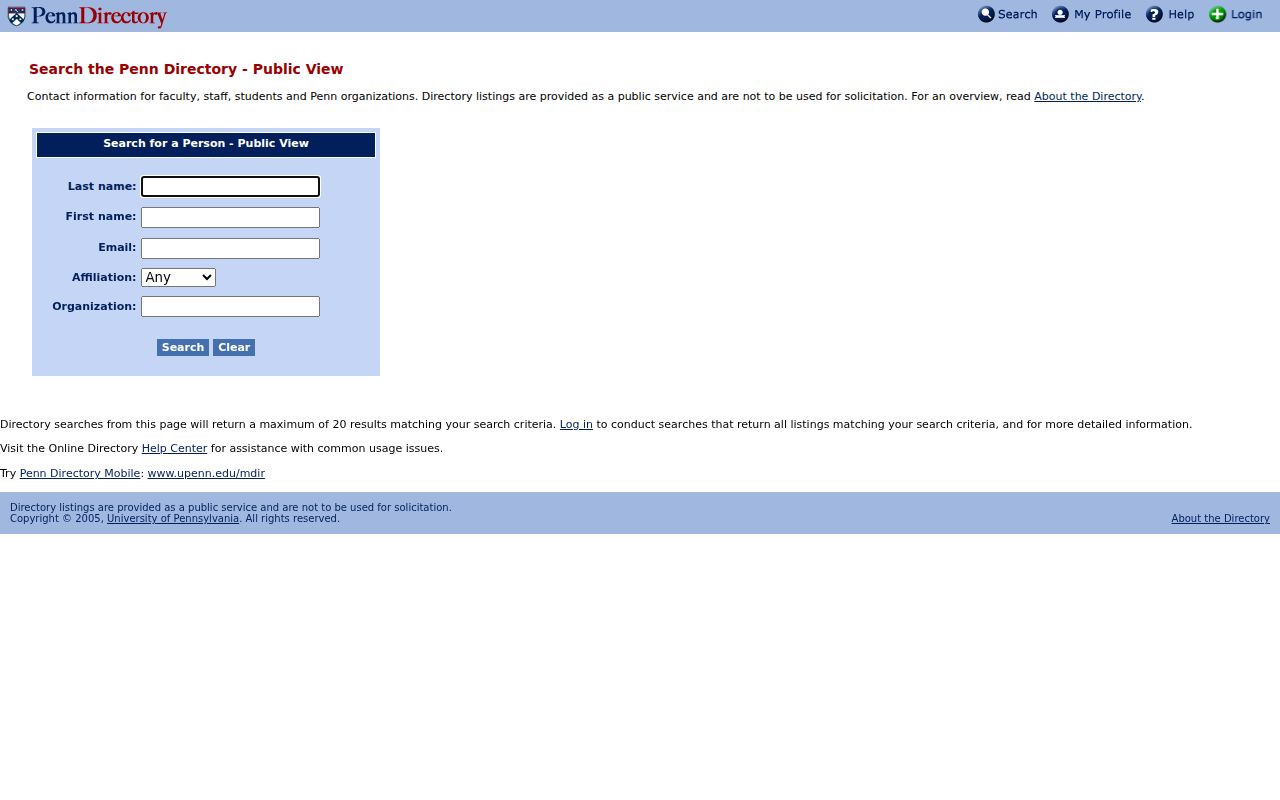
The Penn Directory public search covers faculty, staff, students, and Penn organizations, and the page states plainly that the information is offered as a public service and is not to be used for solicitation. A public record generally shows this much:
- Name, for a person or for a Penn organization
- Affiliation, meaning faculty, staff, student, or organization
- Department or office, usually shown for staff roles
- Email, which is available for most public-facing roles
- Phone, shown when it is public, though privacy settings can suppress a direct line
- Campus building and room for many faculty and staff entries
Some fields only appear after a Penn login. A blank phone field means the person opted out, not that the record is incomplete.
Pennsylvania Utility Phone Numbers
Pennsylvania gas and electric companies publish two sets of phone numbers, and mixing them up is the single most common utility mistake. Emergency lines are staffed around the clock and are meant for leaks, downed wires, and anything dangerous. Customer service lines handle bills and appointments during office hours. Utilities also tell customers not to report an emergency through a web form, because nobody may read it for hours.
| Utility or service | Emergency or outage | Customer service |
|---|---|---|
| UGI gas and electric | 800-276-2722, open 24 hours | 800-276-2722, weekdays 8 AM to 5 PM |
| Peoples Natural Gas | 1-800-400-4271 for a leak, gas odor, damaged line, or carbon monoxide symptoms | Contact page, not for urgent requests |
| Philadelphia Gas Works | Confirm the current emergency line on the PGW contact page | 215-235-1000 |
| PECO, PPL, and the FirstEnergy companies | Company outage line, published on each company site | Company billing line, published on each company site |
| Pennsylvania One Call | Dial 811 before digging, or 800-242-1776 from a number outside Pennsylvania | |
| PennDOT roads | Dial 511 for conditions, or 1-877-511-PENN | 1-800-FIX-ROAD for potholes and roadway concerns |
| Public Utility Commission | Not an emergency line | 1-800-692-7380 |
Water and sewer is the most local layer of all. Depending on the block it may be a municipal authority, a city water department, or a private company, and each keeps its own emergency and billing lines. The FirstEnergy family in Pennsylvania covers Met-Ed, Penelec, Penn Power, and West Penn Power, and which one serves you depends on territory rather than county.
When the utility itself will not solve the problem, the regulator is the next stop.
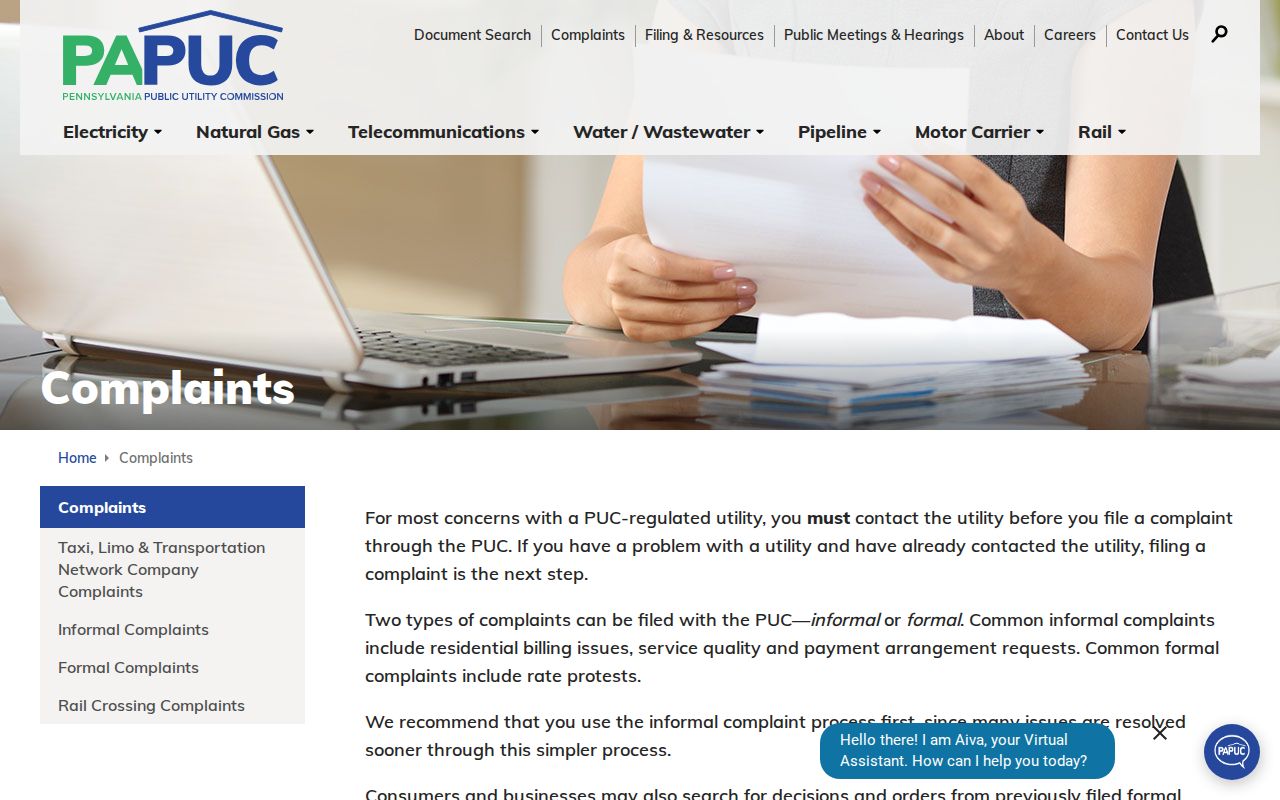
The Public Utility Commission complaint page gives consumers 1-800-692-7380 and an online contact route. Formal complaint forms are separate, and the Secretary's Bureau will mail them on request at 717-772-7777. The PUC regulates the companies but does not dispatch crews, so a leak still goes to the utility emergency line and, if there is immediate danger, to 911.
Health and Social Services Numbers in Pennsylvania
The health layer splits between statewide lines and county-run programs, and knowing which is which saves a transfer. The Department of Health takes public health emergencies and immediately notifiable conditions at 877-PA-HEALTH, which dials as 877-724-3258, and that line is staffed 24 hours a day. Poison emergencies go to 1-800-222-1222.
Behavioral health starts at 988 and then goes local. State law requires every county to make crisis intervention available, so there is a county crisis line behind the statewide number. County human services pages list it, and PA 211 will find it if you do not know where to look. Substance use treatment referrals run through the Get Help Now line at 1-800-662-HELP, which the Department of Drug and Alcohol Programs connects to treatment providers. The state reported more than 6,200 treatment referrals from that line in a single year.
Benefit programs are the one area where numbers move around. Medicaid and SNAP routing changes as the Department of Human Services reorganizes services, and PA Enrollment Services lists the DHS Statewide Customer Service Center at 1-877-395-8930, with 215-560-7226 for Philadelphia, in the context of address and phone changes. Confirm the current number on the DHS or COMPASS page before relying on it, because that is exactly the kind of line that gets replaced quietly.
Vital Records and Licensing Numbers in Pennsylvania
Pennsylvania splits records between the state and the counties, and the split is consistent enough to memorize. Birth and death certificates are state records, handled by the Department of Health's Division of Vital Records. Marriage licenses, wills, and estates are county records, held by the register of wills or the clerk of orphans' court. Deeds and mortgages are county records at the recorder of deeds. Property assessment and tax claim are county. Voter registration is administered by the county, with the Department of State as the statewide authority.
For a birth or death certificate, the Vital Records help line is 724-656-3100 or toll free 844-228-3516. In-person service exists at public offices, and the Philadelphia Vital Records Office moved to appointment-only service starting October 6, 2025, with appointments available only through Pennsylvania Vital Records rather than a third party.
Professional licensing is entirely state-level. The Bureau of Professional and Occupational Affairs answers at 1-833-367-2762, and individual licensing boards publish their own board contacts. Business registrations run through the Department of State's Corporation Bureau, and that office restructures often enough that the current bureau line should come from the Department of State contact page rather than an old listing.
Building permits, zoning, rental licenses, and code enforcement are municipal or county, depending on where you are. Search the municipality first, then the county planning or building department, then the authority if an authority provides the service. Passport acceptance is not a single office either, since a post office, a county prothonotary, or a clerk's office may all accept applications.
Court Phone Numbers Across Pennsylvania
Courts are the best-organized phone layer in Pennsylvania, and it is not close. The Unified Judicial System publishes statewide contact directories, so you do not have to hunt county by county. The clerks of courts directory gives every county a row with the clerk's name, the courthouse address, a phone, and a fax. Adams County is 717-337-9806, Allegheny is 412-350-5322, Armstrong is 724-548-3251, Beaver is 724-770-4586, Bedford is 814-623-4833, Berks is 610-478-6550, Dauphin is 717-780-6530, and Delaware is 610-891-4224.
The magisterial district judge directory covers the other end of the system. Those offices handle preliminary criminal proceedings, traffic citations, landlord and tenant disputes, small claims, summary offenses, and local ordinance cases everywhere outside Philadelphia's separate municipal court structure. Each entry shows a district number in a format like 05-2-01, the judge's name, the office address, a phone, a fax, and a map link.
Statewide court contacts round it out. Attorney registration questions go to 717-231-3380, and the Supreme Court page names a language access contact at 717-231-3313. Federal numbers depend on the district, and the Eastern District's clerk's office general line is 215-597-7704 with a jury department at 267-299-7299 or 800-829-0189.
Public defenders do not have a statewide intake number. Each of the 67 counties runs its own office, and you need the office in the county where the case was filed. For civil matters, the Pennsylvania Legal Aid Network routes people by location and problem, and the Pennsylvania Bar Association handles lawyer referral, which is separate from free legal services.
County and Municipal Numbers in Pennsylvania
County government carries an unusual amount of weight in Pennsylvania, and 67 counties means 67 different phone pages. Counties run elections, deeds, assessment, tax claim, the sheriff, the district attorney, the public defender, the prison, children and youth services, the area agency on aging, veterans affairs, drug and alcohol programs, emergency management, and the 911 center. Larger counties publish a department-by-department directory. Smaller ones publish a short list and a switchboard.
The difference in depth is easy to see. A large county directory will list an administrator's office, an agency on aging, archives, assessment and tax claim, commissioners, children youth and families, a coroner, court administration, elections, emergency management, human services, a juvenile detention center, a prison, a public defender, a recorder of deeds, a register of wills, a sheriff, a treasurer, veterans affairs, and the county 911 office. A rural county may publish direct lines for a handful of programs and route everything else through one main number.
Municipal numbers are thinner still. Expect a main office, a police non-emergency line where there is a local department, public works, zoning and code enforcement, and a tax collector. Pennsylvania local tax collection is genuinely confusing, because it can involve a municipal collector, a school district collector, the county, or an earned income tax bureau. Philadelphia runs Philly311 and Pittsburgh runs a 311 Response Center, but 311 is a city program in Pennsylvania and does not route from anywhere else.
Reverse Lookup Through Official Channels
Government tools will not tell you who called. That is worth saying up front, because it is the most common false expectation. What they will do is tell you whether a Pennsylvania number is legitimate, where its prefix was assigned, and how to file a complaint that goes somewhere. Start there, especially if the call involved a threat, a payment demand, or a spoofed government name.
The federal complaint portal is where most of this begins.
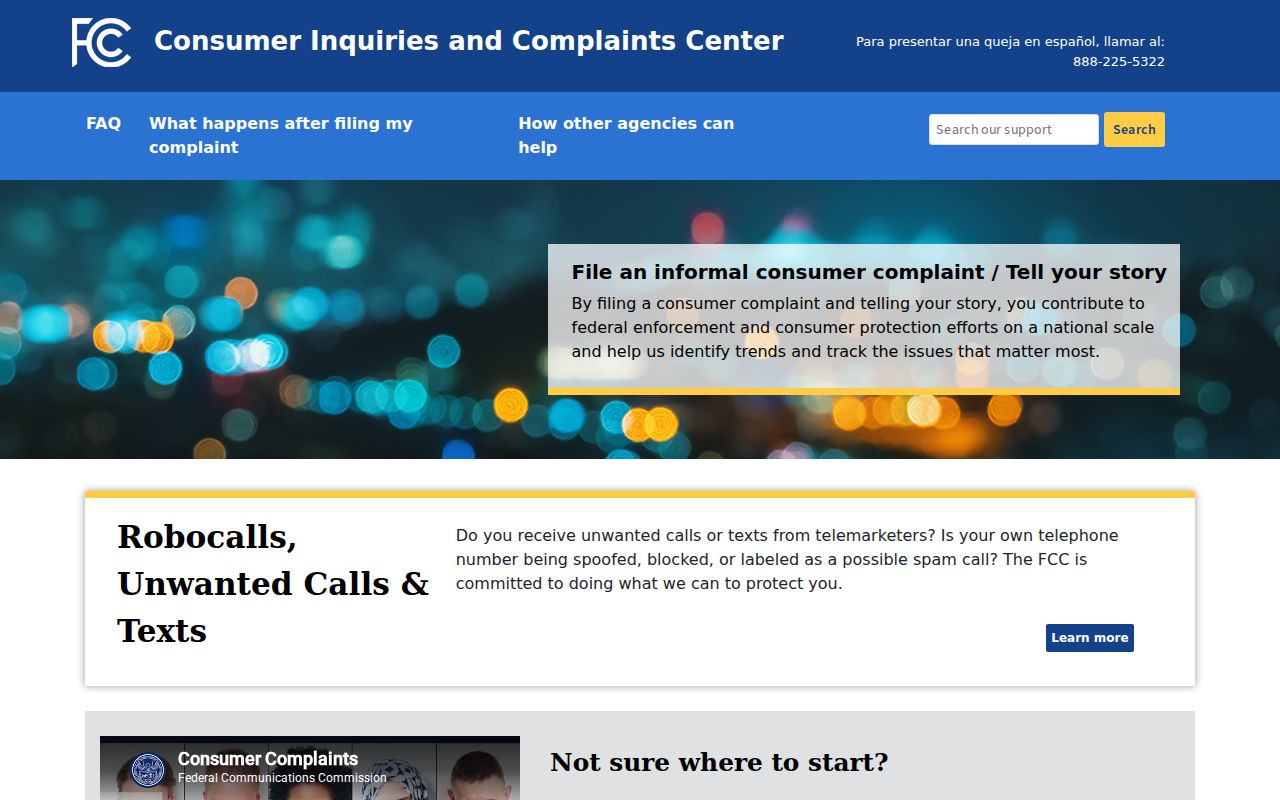
The FCC Consumer Complaint Center separates unwanted calls and texts, spoofing of your own number, blocking and labeling problems, and billing or service issues, with sub-issues for robocalls and robotexts underneath. International-format numbers go in the description field. The FCC also takes informal complaints by phone at 1-888-225-5322, with ASL video and mail options available.
- Write down the calling number, the date and time, and anything the voicemail actually said before you do anything else.
- Check the area code and prefix against NANPA's records to see where the number was originally assigned and which company received the block.
- File with the FCC if the call was a robocall, a spoof, or a mislabeled number.
- File with the FTC Do Not Call Registry if it was telemarketing and your Pennsylvania number has been registered for at least 31 days.
- File with the Attorney General if it looked like fraud, and with the PUC if a utility was involved.
One official database gets misunderstood a lot. The Reassigned Numbers Database exists so businesses can check whether a number they had permission to call has been handed to a new person. It is a prepaid subscription service for callers and their agents, and it returns a status rather than a name, so it is not a consumer who-called-me tool.
Third-Party Reverse-Lookup Tools
Everything in this section is a commercial product. None of these companies are government agencies, none of them have access to carrier subscriber records, and their results are clues rather than verification. They are still useful, especially for spotting a Pennsylvania number that thousands of other people have already flagged.
| Tool | Free? | Returns name | Returns carrier | Returns line type |
|---|---|---|---|---|
| Whitepages | Freemium | Often, with full reports paid | Sometimes | Sometimes |
| NumLookup | Free for basic results | Often | Limited | Limited |
| Truecaller | Freemium, app based | Crowd-sourced name or spam tag | Limited | Limited |
| RoboKiller | Freemium, blocking is paid | Spam identity only | Spam category | Limited |
| YouMail Directory | Free to browse | Spam labels and business names | Limited | Limited |
| Carrier apps | Free with your line | Spam or business label | Your own carrier only | No |
The paid tools tend to front-load a name and then ask for money before showing the detail.
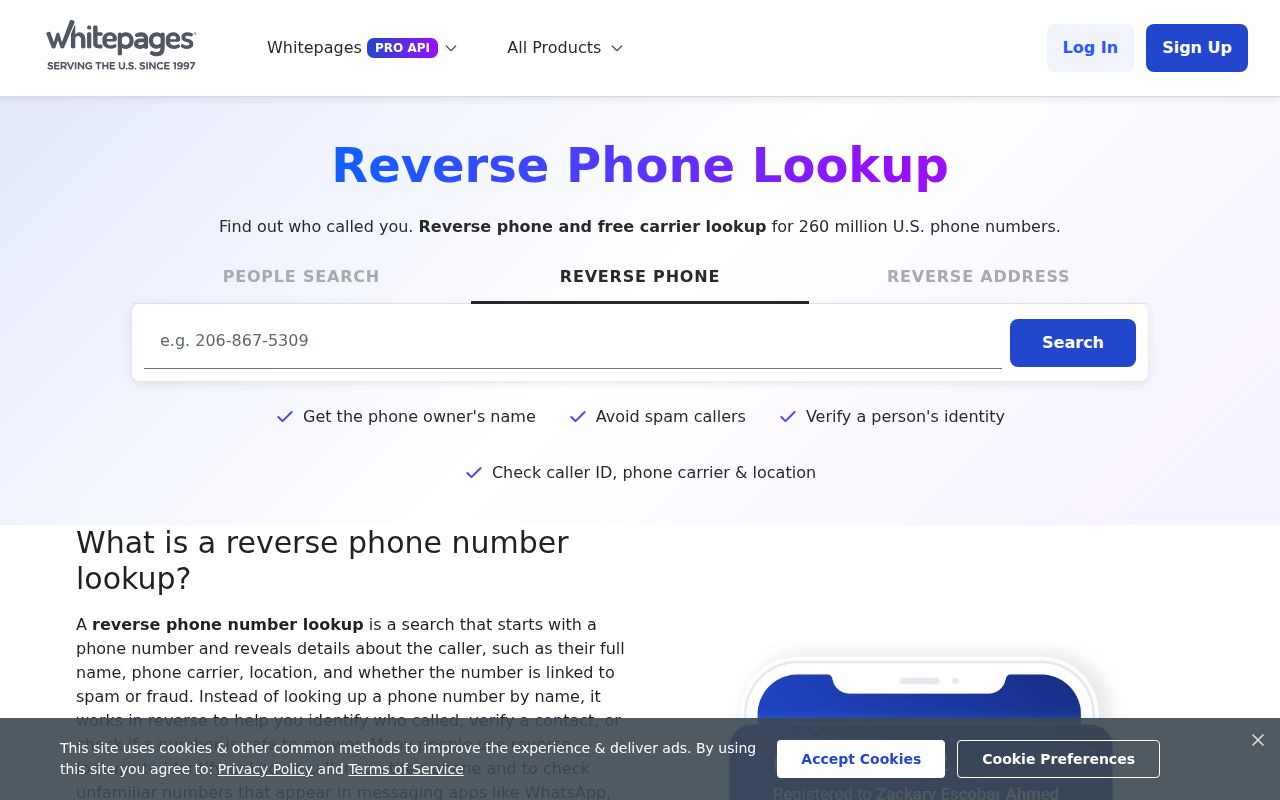
The Whitepages reverse phone search takes a number and returns a preview, with the full report behind a paywall. Free tools are blunter and faster.
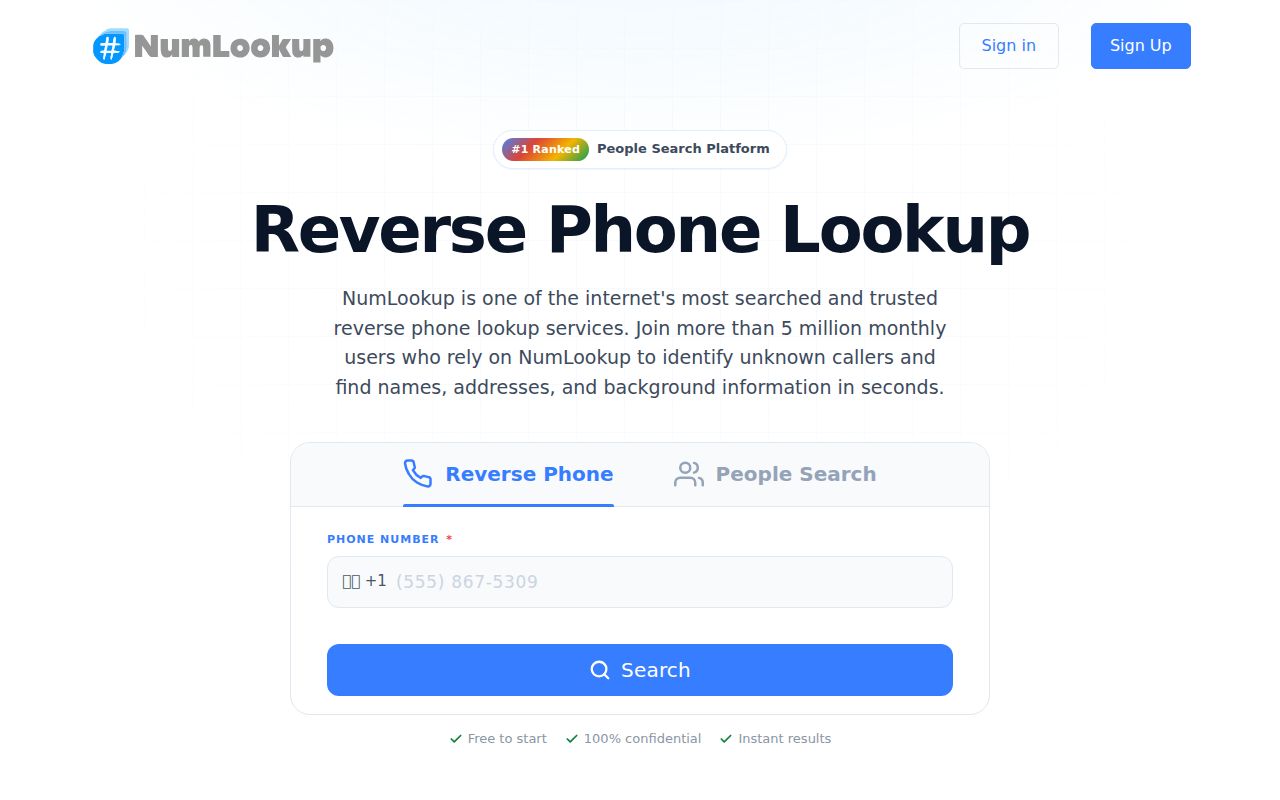
NumLookup asks for a ten-digit number and nothing else. Reputation tools answer a different question entirely: Truecaller, RoboKiller, and the YouMail directory report what other people have flagged about a number rather than who owns it. Your own carrier covers your line for free through AT&T ActiveArmor, Verizon Call Filter, or T-Mobile Scam Shield.
Identifying Line Type and Carrier
Line type changes what a Pennsylvania phone number can actually do. Landlines often cannot receive texts and report a fixed service address to emergency systems. Wireless numbers move between carriers freely and get filtered by carrier spam apps. VoIP numbers are ordinary for businesses, schools, hospitals, and remote staff, and they are also the cheapest kind of number for a scammer to buy and throw away. Toll-free numbers tell you an organization is paying for the call and tell you nothing at all about geography.
The prefix lookup people rely on is weaker than it looks. NANPA's central office code records show the state, the NPA-NXX, the operating company number, the company name, and the rate center, which sounds definitive. It is not. Portability lets a subscriber keep a number when moving to a different carrier, so the company on record may have nothing to do with the current one. Wireless pooling assigns numbers in thousand-blocks, so one prefix can be split across several companies. And a VoIP provider can issue a 412 number to a customer who has never set foot in Allegheny County. The prefix is where the number started, not where it is now.
Pennsylvania's carrier landscape reflects that history. Verizon is the Bell successor across much of the state, Frontier serves other incumbent territories, and Comcast, Spectrum, Astound and other cable or competitive providers carry voice lines. AT&T, Verizon, T-Mobile, and regional carriers cover mobile, and resellers such as Cricket, Visible, Mint Mobile, Boost, Metro, Tracfone, Consumer Cellular, and Straight Talk ride on those same networks. What that means for a lookup is simple. Treat the carrier result as one data point next to the spam label, the prefix, and whatever the caller actually said.
Note: read the caller ID checkmark, the carrier spam label, and the prefix result together, because any one of them alone will mislead you often enough to matter.
Reporting Scam Calls in Pennsylvania
Reporting a bad call works best as three filings, not one. Federal, Pennsylvania, and carrier channels each see a different slice of the problem, and none of them share a queue. It takes about ten minutes total once you have the caller's number and the details written down.
The registry is the piece most people already know about.
The National Do Not Call Registry handles registration and reporting, and the FTC asks that you wait until your number has been registered for 31 days before reporting an unwanted telemarketing call. The registry stops legitimate telemarketers. It does nothing to criminals, and political, charitable, and survey calls sit outside its rules entirely.
State channels matter just as much here. The Attorney General's complaint portal routes consumer complaints, Pennsylvania Do Not Call complaints, and scam reports, and the scam forms are published in Spanish, Cambodian, Korean, Simple Chinese, and Vietnamese alongside English. The main office line is 717-787-3391. In 2025 the office launched Operation Robocall Roundup, warning dozens of telecom companies accused of ignoring federal robocall rules, which shows the state is going after the carriers routing illegal traffic and not only the individual callers.
The scripts that work in Pennsylvania lean on local names. Callers impersonate the Attorney General's office, a county sheriff, a court clerk chasing a jury summons, the IRS, or Social Security. Utility shutoff threats spoof PECO, PPL, UGI, PGW, Peoples, and municipal authorities. Grandparent scams use a spoofed local number and, increasingly, a cloned voice. Bank fraud calls ask you to read back a one-time code. And 988 is a crisis line, not a collection agency, so any call claiming otherwise is not from 988.
Community Resource Directories in Pennsylvania
PA 211 is the most useful non-government phone resource in the state. It is a live, searchable directory of local help covering housing, utilities, food, health, disaster recovery, caregiving, transportation, employment, and childcare. Three ways in: dial 211, text your ZIP code to 898-211, or search online. It runs every day of the year, it is free and confidential, and it advertises support in 240 languages. United Way of Greater Lehigh Valley also lists 855-567-5341 as an alternate line.
The ZIP-code text is what makes it work across a state this varied. What is available in Philadelphia is not what is available in a Potter County borough, and the ZIP tells the system which county's resource set to search.
Below the statewide layer, county directories are almost always more precise. Area agencies on aging, county human services, county drug and alcohol offices, community action agencies, and local United Way affiliates each maintain their own. Large health systems and universities run their own switchboards too, and those numbers show up constantly in reverse lookups because appointment reminders, billing offices, admissions, and campus alerts all dial out from them. If a Pennsylvania area code and an unfamiliar prefix call you twice in a week, a health system or a school is a likelier explanation than a scam, and the area code page will tell you which part of the state the number came from.