
Every Area Code Serving Pennsylvania
Fifteen area codes are in service across Pennsylvania today, and four of them are original. When the numbering plan was drawn up in 1947, the Commonwealth received 215 for Philadelphia and the southeast, 412 for Pittsburgh and the western corner, 717 for the middle of the state, and 814 for the northwest and the north central counties. Those four held up for roughly fifty years. Cell phones, fax lines, and second household lines then drained the supply, and the Pennsylvania Public Utility Commission says the original codes were in jeopardy by the late 1990s. Every code added since is either a split off one of the four or an overlay sitting on top of a region that already had one.
Pennsylvania leaned on overlays after 1999. An overlay moves nobody. It simply hands new customers a newer code, so a line installed last year in a Reading or Scranton neighborhood may not match the line installed next door in 1985.
| Area Code | Coverage | Year Assigned | Overlay Status |
|---|---|---|---|
| 215 | Philadelphia and the close southeast, including Philadelphia County and nearby Bucks and Montgomery communities | 1947 | Original code |
| 267 | Same ground as 215 | 1999 | Overlay on 215 |
| 445 | Same ground as 215 and 267 | 2018 | Overlay on 215 and 267 |
| 610 | Lehigh Valley, Reading, Chester, Delaware County and the suburban ring west and north of Philadelphia | 1994 | Split from 215 |
| 484 | Same ground as 610 | 1999 | Overlay on 610 |
| 835 | Same ground as 610 and 484 | 2022 | Overlay on 610 and 484 |
| 717 | Harrisburg, Lancaster, York, Carlisle, Chambersburg, Gettysburg, Lebanon and south central Pennsylvania | 1947 | Original code |
| 223 | Same ground as 717 | 2017 | Overlay on 717 |
| 570 | Scranton, Wilkes-Barre, Williamsport, Bloomsburg, Danville, Monroe County and the Poconos | 1997 | Split from 717, in service April 1999 |
| 272 | Same ground as 570 | 2013 | Overlay on 570 |
| 814 | Erie, State College, Altoona, Johnstown, Clearfield, Somerset and Potter County | 1947 | Original code |
| 582 | Same ground as 814 | 2021 | Overlay on 814 |
| 412 | Pittsburgh and much of Allegheny County | 1947 | Original code |
| 724 | Washington, Greensburg, Indiana, New Castle, Uniontown, Butler and the surrounding southwest | 1998 | Split from 412 |
| 878 | Same ground as 412 and 724 | 2001 | Overlay on 412 and 724 |
Note: These Pennsylvania groupings follow numbering regions rather than county lines, so a single code can serve part of a county without covering all of it.
Pennsylvania Area Code Coverage by Region
Pennsylvania's fifteen codes sort into six numbering regions. Philadelphia and the counties pressed against it share one set. The suburban ring west and north of the city, along with the Lehigh Valley and Reading, shares another. South central Pennsylvania around Harrisburg, Lancaster, and York is its own region. The northeast runs from Scranton and Wilkes-Barre through Williamsport and out into the Poconos. The northwest and north central stretch reaches from Erie down through State College and Altoona to Johnstown. Pittsburgh and the southwest make up the sixth. County borders and numbering borders do not line up neatly. The 2022 commission notice for 835 lists all or part of Berks, Bucks, Carbon, Chester, Delaware, Lancaster, Lebanon, Lehigh, Monroe, Montgomery, Northampton, and Schuylkill counties inside that one region, which shows how far a single group of codes can reach.
- Philadelphia and the close southeast - 215, 267, 445
- Lehigh Valley, Reading, Chester, Delaware County, suburban southeast - 610, 484, 835
- Harrisburg, Lancaster, York, Carlisle, Chambersburg, Gettysburg, Lebanon - 717, 223
- Scranton, Wilkes-Barre, Williamsport, Bloomsburg, Stroudsburg, the Poconos - 570, 272
- Erie, State College, Altoona, Johnstown, Clearfield, Potter County - 814, 582
- Pittsburgh and Allegheny County - 412, with 878 over it
- Washington, Greensburg, Indiana, New Castle, Uniontown, Butler - 724, with 878 over it
The Pennsylvania regulator keeps the whole picture in one place, with a statewide map plus separate maps for each overlay complex.
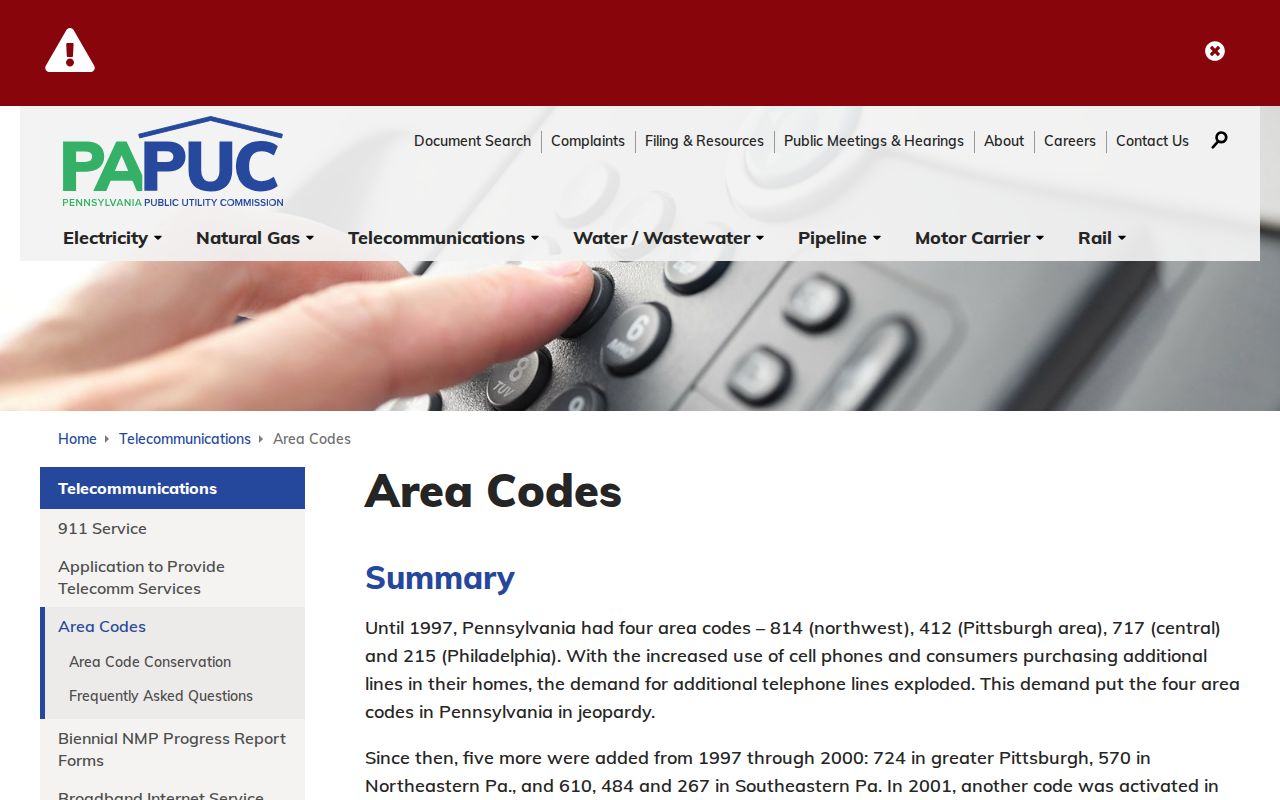
The regional PDFs on the PA PUC area code page break out 412/724/878, 570/272, 610/484, 215/267/445, 717/223, and 814 as separate drawings, which helps when a Pennsylvania town sits near a boundary. The same page carries the commission consumer hotline, 1-800-692-7380, for numbering and service questions.
How Pennsylvania Split and Overlaid Its Codes
Splits and overlays solve the same problem. A region runs low on unassigned prefixes and needs more numbers. The split was the older answer, and Pennsylvania used it three times in the 1990s. In 1994, 610 came out of 215 and took much of southeastern Pennsylvania outside Philadelphia. In 1998, 724 came out of 412 and took the Pittsburgh suburbs plus the counties beyond them. The 717 region was carved up next, and the change took hold in April 1999, with the southern half keeping 717 while the northern half became 570. Splits are hard on people. Signs, letterhead, business cards, and every printed flyer go stale on the cutover date.
After 1999 the Commonwealth stopped cutting regions apart. Everything added since has been an overlay: 267 and later 445 across Philadelphia, 484 and later 835 across the 610 region, 878 across Pittsburgh and the southwest, 272 across the northeast, 223 across south central Pennsylvania, and 582 across the northwest. Not one Pennsylvania customer had to change a number for any of them. The trade is the dialing rule, since a region with two or three codes cannot let a bare seven digit number stand on its own.
- NPA
- Numbering plan area, which is the formal name for an area code. It is the first three digits of a ten digit Pennsylvania number.
- NXX
- The three digits right after the area code. Phone companies call it a central office code, and it points at a billing area rather than a street.
- Overlay
- A second or third code laid over a region that already has one. Nobody surrenders a number. New lines come out of the newer code, and every local call needs all ten digits.
- Split
- The older method. A region gets cut in two, one half keeps the old code, and the other half has to change its numbers.
- Permissive dialing
- The grace window before a new rule is enforced. Calls connect either way during it, and the short form stops working once the window closes.
Dialing Rules Across Pennsylvania
Ten digits is the working rule almost everywhere in Pennsylvania. Inside an overlay region the same seven digit number can exist under two or three different codes, so the switch has no way to guess which one a caller meant. The Pennsylvania commission stated the pattern plainly in its 835 notice: local and toll calls inside 610, 484, and 835 are dialed as ten digits, calls from that region to a different area code are dialed as 1 plus the ten digits, and operator services are reached with 0 plus the ten digits.
Important: Ten digit dialing is required in every Pennsylvania overlay region, and some toll calls still need a 1 in front of those ten digits.
Parts of Pennsylvania got used to this a long time ago. The commission pointed out that callers in 610 and 484 had already been dialing ten digits for more than twenty years by the time 835 went live in 2022. The last seven digit holdouts were pushed over by a federal change instead of a state one. So that 988 could work as a national crisis line, the FCC required ten digit dialing in any area where 988 was also a live local prefix, with a deadline of October 24, 2021. Star codes, N11 numbers, and toll free prefixes fill out the rest of the Pennsylvania phone codes a resident actually dials.
Pennsylvania Area Code History by Year
The Pennsylvania pattern is easy to follow once the dates line up. Fifty quiet years, then a burst of splits in the 1990s, then a steady drip of overlays that continues into the 2020s. Number conservation slowed things down for a while. Pooling and reclamation stretched the supply enough that the northeast waited until 2013 for a second code, south central Pennsylvania waited until 2017, and the northwest waited until 2021.
| Year | Event |
|---|---|
| 1947 | 215, 412, 717, and 814 assigned to broad regions of the Commonwealth |
| 1994 | 610 placed in service as a split from 215 across much of the southeast |
| 1997 | 570 created out of the northern part of the 717 region |
| 1998 | 724 split from 412 on February 1 for the Pittsburgh suburbs and the southwest |
| 1999 | 717 split takes effect in April; 267 overlays 215 and 484 overlays 610 in June |
| 2001 | 878 starts July 12 as an overlay for both 412 and 724 |
| 2013 | 272 goes into service October 21 over the 570 region |
| 2017 | 223 goes into service September 26 over the 717 region |
| 2018 | 445 goes into service March 3 over 215 and 267 |
| 2021 | 582 implemented over 814 after permissive dialing and the 988 changeover |
| 2022 | 835 opens for new assignments in the 610 and 484 region on September 2 |
Two of those years did double duty. The 1999 entry covers a split and two overlays, which made it the busiest single year in the Pennsylvania numbering record.
Prefixes Inside a Pennsylvania Area Code
Under every area code sits a layer of three digit prefixes. A full number reads as area code, prefix, then the four digit line number. The prefix is assigned to a rate center, which is a billing and geographic unit rather than a building on a specific corner. Pennsylvania rate centers carry names people recognize, such as Philadelphia, Allentown, Reading, Harrisburg, Lancaster, Scranton, Erie, and Pittsburgh. That is why a prefix used to be a decent guess about where a caller sat.
It is a weaker guess now. Number portability lets a customer keep a number while switching carriers, so the company listed against a prefix may not be the company serving the line today. Pooling changed things too. The Pennsylvania commission says mandatory thousands block pooling started in June 2010, which means a single prefix can be carved into blocks of a thousand numbers and shared among several carriers. For anyone trying to place an unknown caller, a prefix is a clue and never proof.
The national administrator publishes the raw assignment records for anyone who wants to check a prefix by hand.
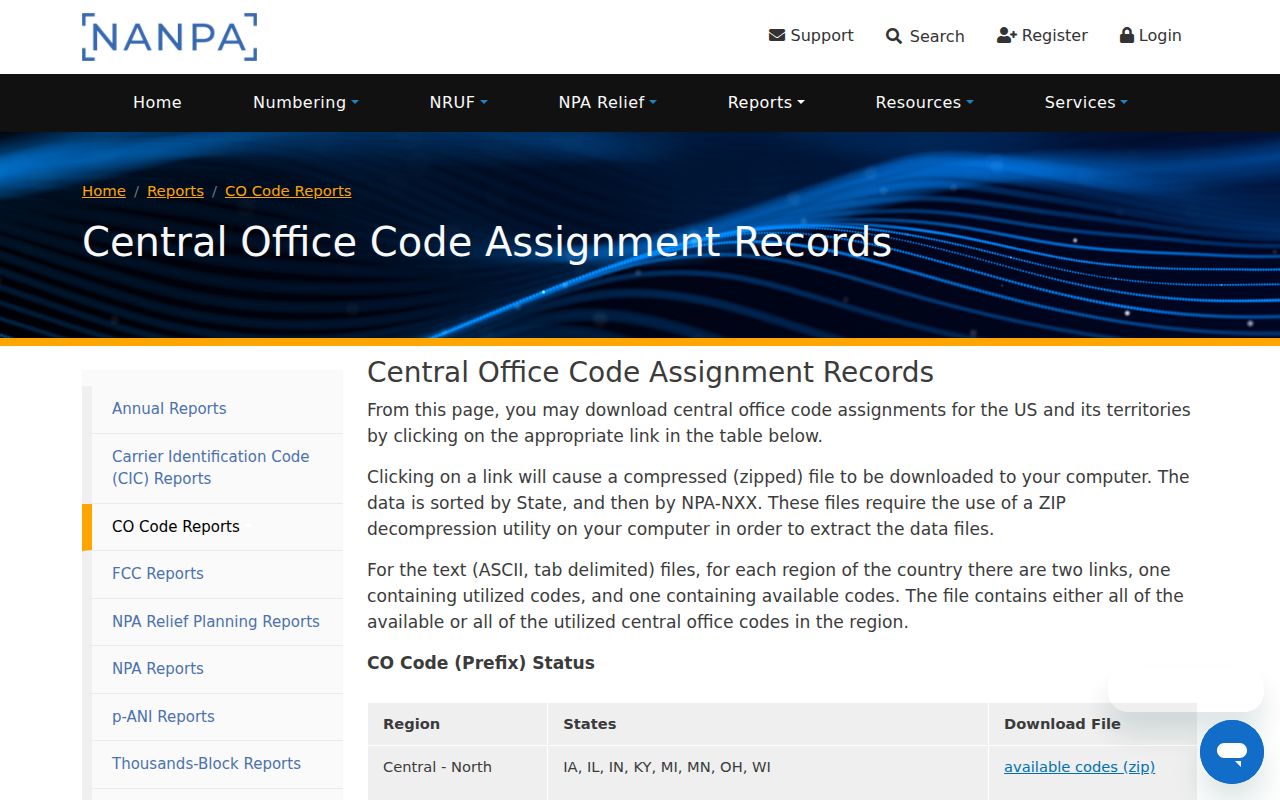
Files on the NANPA central office code assignment page are sorted by state and then by area code and prefix, and each record carries the state abbreviation, the prefix, an operating company number, the company name, and the rate center. NANPA warns that these public files do not include everything needed for routing and billing, so treat them as a reference rather than a complete carrier database.
Why Old Pennsylvania Codes Still Stick
Overlays are technically equal. Culturally they are not. Say 215 anywhere in Pennsylvania and people hear Philadelphia. The 412 code is Pittsburgh's badge, printed on shirts and worked into business names. Ask about 717 and you get the Harrisburg, Lancaster, and York belt. The 814 code covers an enormous stretch, from Erie down to Johnstown and across to State College, and residents there still use it as shorthand for that whole half of the map.
The newer Pennsylvania codes have not earned that yet. A 445, 835, 223, 272, 582, or 878 number sits in the exact same neighborhood as its older neighbor, but nobody names a bar after it. This is worth remembering when a caller ID looks unfamiliar. A code you do not recognize is not automatically an out of state number.
Note: Overlay codes carry no separate geography, so a 878 number and a 412 number can both belong to the same Pittsburgh street.
Future Area Codes for Pennsylvania
No sixteenth Pennsylvania code has been announced. Official NANPA and commission material shows the eight active overlays as the current relief plan, with nothing new named beyond them. That can change quietly, because relief planning starts long before a code appears on a phone. The national administrator publishes exhaust forecasts on a rolling basis, and its reports page listed an April 2026 set of exhaust analysis files along with a July 6, 2026 update to the number resource utilization data.
If a new code ever is needed, the Pennsylvania Public Utility Commission takes part in approving it and in choosing the relief method. Based on the last twenty five years of Pennsylvania practice, an overlay is the likely answer, and an overlay asks almost nothing of existing customers. Numbers stay put. The dialing rule in those regions is already ten digits, so most people would notice only when a neighbor got a number starting with three digits they had never seen.
Monitoring is straightforward, since the relief reports live in one public spot.
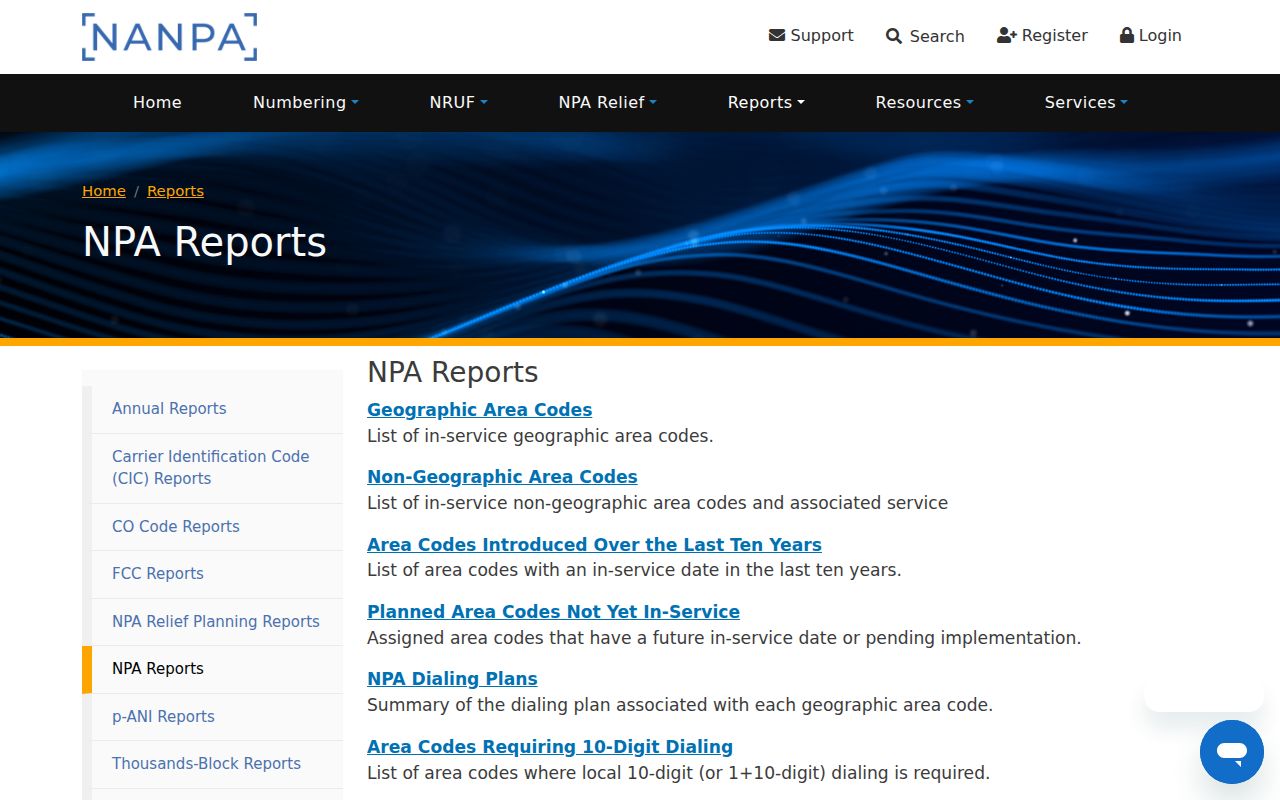
The NANPA area code reports hub collects the geographic code list, the dialing plan files, the ten digit dialing list, planned codes, and the numbering plan database in one index. Anyone tracking a possible new Pennsylvania code should watch the relief planning and exhaust files there first.
Verifying a Pennsylvania Area Code
Two sources settle almost any question about a Pennsylvania code. The national administrator confirms whether three digits are a real, active geographic code and which state holds it. The state commission confirms which Pennsylvania region that code serves and when it started. Between them you can check a suspicious caller ID, confirm a code on a form, or work out whether a number belongs to the part of the state you expected.
One caution is worth carrying into that check. The commission area code page still describes Pennsylvania as having thirteen area codes, a figure written before the newest two arrived. Later commission releases cover 835, and current national data covers 582, which brings the real total to fifteen. When two official pages disagree, the newer release and the national administrator record are the ones to trust.
Note: Older Pennsylvania pages can lag behind an activation by months, so check the assignment date on any code that looks unfamiliar.