
How to Find Phone Numbers in Pennsylvania
There is no single phone book covering all of Pennsylvania, and there never really was. What Pennsylvania has instead is a stack of directories that each cover one slice. The Department of General Services publishes the Commonwealth Telephone Directory, which is the official book for state agency numbers. The General Assembly runs a separate directory for legislative offices. The courts publish their own county lists. Counties, boroughs, and townships each post whatever they choose to post. Schools and universities keep their own staff searches. So the first move is not to search harder. The first move is to figure out who the number belongs to.
Once you know the owner, the path through the Pennsylvania phone directory is usually short. State office numbers come out of the Commonwealth directory. County office numbers come from the county website or a statewide court list. Local numbers come from the borough or township site, and in small municipalities that may be a single main office line. When nothing is published, there is still a fallback chain: call the main office during business hours, ask the county switchboard to route you, or file a Right-to-Know Law request with the local open-records officer for records that are not exempt.
The order below works for most searches.
- Start with the Commonwealth Telephone Directory if the number belongs to a state agency, bureau, or program office.
- Go to the county website if the office handles deeds, elections, assessment, human services, the jail, or the courts.
- Go to the borough, township, or city site for local police non-emergency, public works, zoning, and tax collection.
- Use the school district or university directory for anyone who works at a school or campus.
- Dial 211 when you are not sure which office handles the problem at all, since PA 211 is a live referral service rather than a list.
- File a Right-to-Know request only after the published channels come up empty.
The Commonwealth directory itself is a PDF rather than a live database, which surprises people who expect a search box.
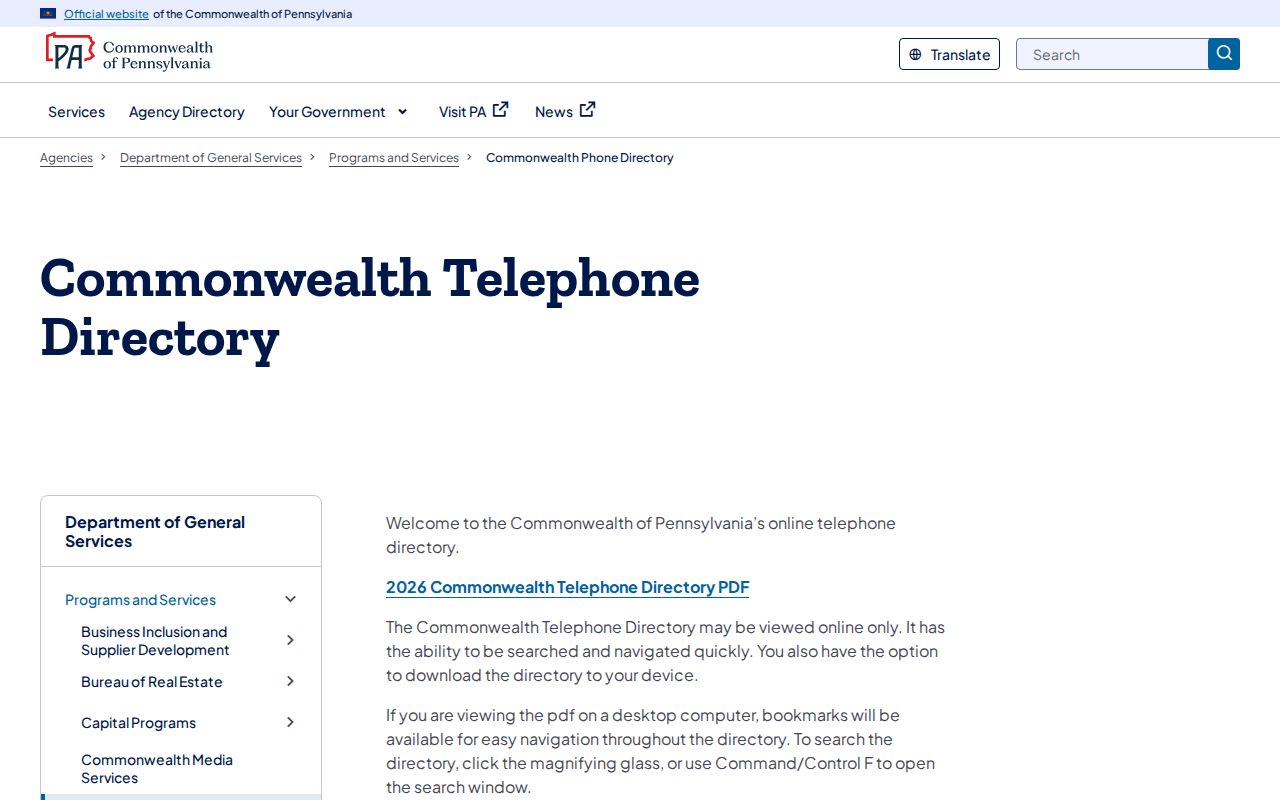
The Department of General Services page says the directory can be viewed online, searched and navigated quickly, and downloaded to your device, and the 2026 edition is the current file. In practice you open the PDF and use your browser's find tool to hunt for an agency, a bureau, or a name.
Area Codes Serving Pennsylvania
Fifteen area codes serve Pennsylvania right now. That number surprises people who grew up here, because for fifty years there were only four. The 1947 numbering plan gave the state 215 for Philadelphia and the southeast, 412 for Pittsburgh and the west, 717 for the center, and 814 for the northwest. Cell phones and second household lines burned through those four faster than anyone planned. The 1990s brought splits, and everything since has been an overlay.
An overlay means a second code gets laid on top of the same ground. Nobody has to change a number they already have. New numbers just come out of the newer code. That is why a Philadelphia number can be 215, 267, or 445, and why two neighbors in Allentown can have different area codes. The trade is that ten-digit dialing becomes mandatory, since the same seven digits can now exist twice in one town.
| Area Codes | Part of Pennsylvania | Places You Would Recognize |
|---|---|---|
| 215 / 267 / 445 | Philadelphia and the close southeast | Philadelphia, plus nearby Bucks and Montgomery County communities |
| 610 / 484 / 835 | Lehigh Valley, Reading, and the suburban southeast | Allentown, Bethlehem, Reading, West Chester, Media, Chester, Pottstown |
| 717 / 223 | South-central Pennsylvania | Harrisburg, Lancaster, York, Carlisle, Chambersburg, Gettysburg, Lebanon |
| 570 / 272 | Northeast and north-central Pennsylvania | Scranton, Wilkes-Barre, Williamsport, Bloomsburg, Stroudsburg, the Poconos |
| 814 / 582 | Northwest, north-central, and west-central Pennsylvania | Erie, State College, Altoona, Johnstown, Clearfield, Somerset, Potter County |
| 412 / 724 / 878 | Pittsburgh and the southwest | Pittsburgh and Allegheny County, Washington, Greensburg, Indiana, New Castle, Uniontown, Butler |
The newest two codes are 582, which joined 814 in 2021, and 835, which opened for new assignments in the 610 and 484 region on September 2, 2022. Per-code coverage, the assignment years, and the full split and overlay history sit on the Pennsylvania area codes page.
Note: the Public Utility Commission's own area-code page still describes an older count, so check the current code list against NANPA before relying on it.
Public Safety Phone Numbers in Pennsylvania
Dial 911 when something is happening now. Fire, a crash with injuries, a crime in progress, a medical emergency, a gas leak that needs responders. Do not use 911 for a utility bill question, a road-condition question, directory assistance, or a records request. County 911 centers do have administrative lines, but those are for paperwork, not for emergencies.
911 - police, fire, and medical emergencies happening right now.
988 - the Suicide and Crisis Lifeline. Free and confidential, by call, text, or chat, any hour of the day.
211 - PA 211 for food, housing, utility help, and other local services. You can also text your ZIP code to 898-211.
811 - Pennsylvania One Call, before any digging.
Poison Control - 1-800-222-1222.
Pennsylvania's 988 routing is more local than the national description suggests. The state's 2025 fact sheet says a call, text, or chat goes first to a Pennsylvania crisis center when one is free, then to another Pennsylvania center, and only then to the national backup network. Fewer than two percent of contacts end up on the national backup. Veterans press 1. Spanish-speaking callers press 2.
Non-emergency police depends on where you live. Plenty of Pennsylvania municipalities have no police department of their own, and the State Police cover them instead.
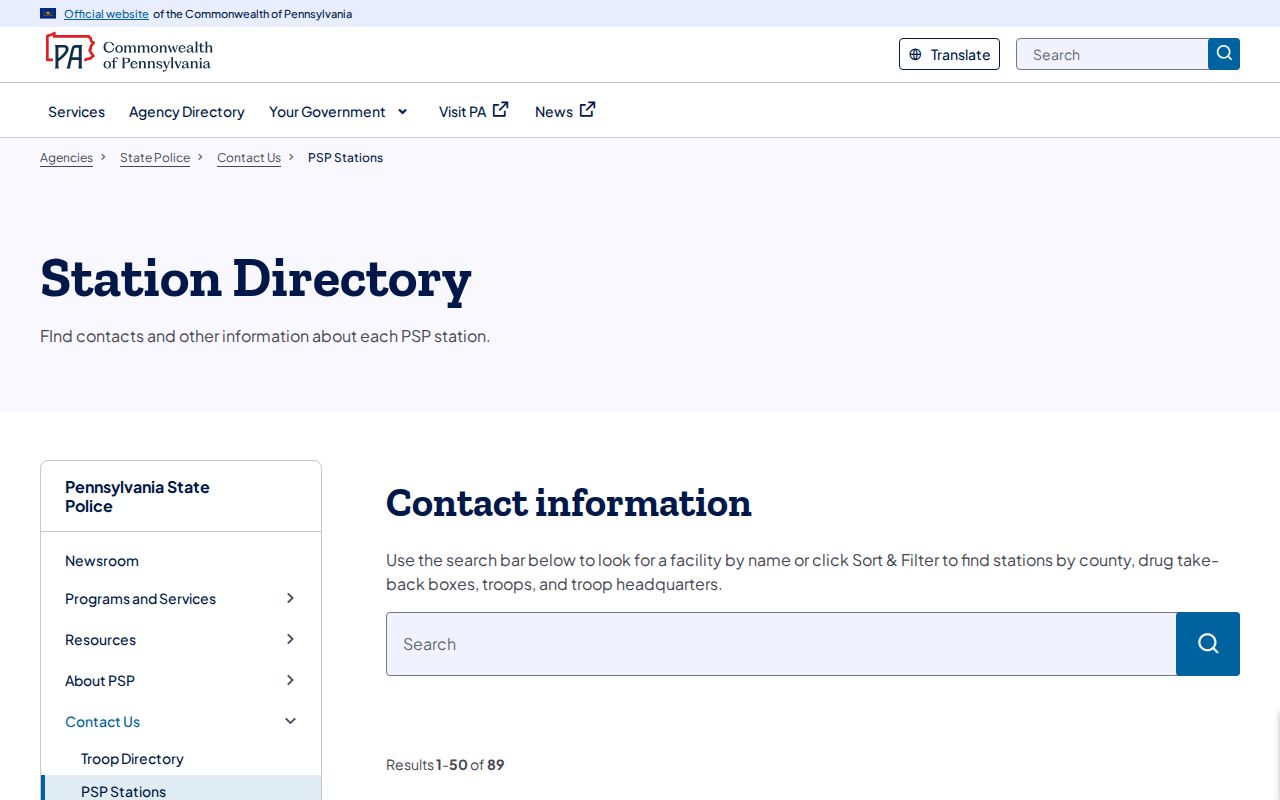
The State Police station directory lists each station with its county, address, phone, and in some troops a TTY or fax line, so you can find the barracks that actually covers your address. Headquarters in Harrisburg answers business-hours calls at 717-783-5599. Troop T patrols the Turnpike, and Turnpike crashes have their own number: dial *11 from a cell phone or 1-800-332-3880.
Two more statewide reporting lines are worth writing down. ChildLine takes child abuse and neglect reports around the clock at 1-800-932-0313. The Statewide Elder Abuse Helpline runs the same way at 1-800-490-8505, and it accepts anonymous reports.
Pennsylvania Government Phone Directories
Three official directories cover most state-level questions in Pennsylvania. The Commonwealth Telephone Directory is the umbrella book for agency and bureau numbers. The General Assembly keeps its own searchable directory for legislative offices. Individual agencies then publish their own program lines, and those are often more useful than the main switchboard, because Pennsylvania agencies route by bureau rather than through one operator.
Commonwealth Telephone Directory
Department of General Services
Official statewide agency phone book
Downloadable PDF, 2026 edition
General Assembly Directory
Pennsylvania House and Senate offices
Search by person, office, phone, or district
Professional Licensing
Bureau of Professional and Occupational Affairs
1-833-367-2762
Licensing boards and license questions
The legislative directory is the one worth learning, because it searches in more than one direction.
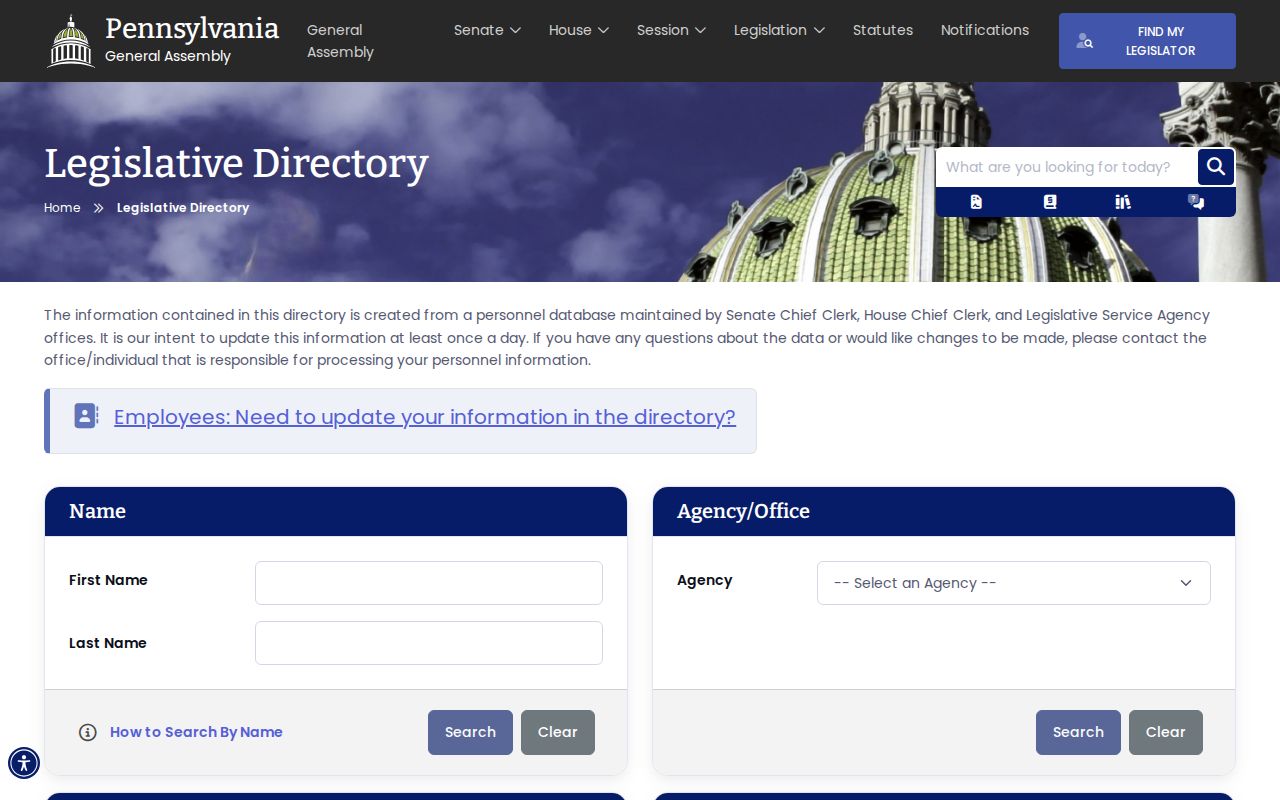
The General Assembly directory lets you start from a name, an office, a building and room, a district city, or even a phone number you already have. These are the fields it exposes.
| Field | Type | Required | Notes |
|---|---|---|---|
| Name | Text search | No | Look up a member or staffer by name |
| Agency or office | Browse list | No | Covers House, Senate, and legislative service offices |
| Phone | Text search | No | Runs in reverse, from a number back to the office |
| Building and room | Text search | No | Handy for offices inside the Harrisburg Capitol complex |
| District city | Text search | No | Finds the member whose district covers a given town |
Local government works differently. Pennsylvania has thousands of municipalities, and a small borough may publish nothing beyond a main office line, a police non-emergency number, a public works number, and the tax collector. Elected officials often list an email and no direct phone. Philadelphia runs Philly311 for city service requests and Pittsburgh runs a 311 Response Center, but 311 is a city service in Pennsylvania and does not route anywhere else in the state.
A Commonwealth directory entry generally shows these pieces.
- Agency or office name, listed section by section
- Bureau, unit, or division where the agency publishes them
- Employee name and title where staff rows are included
- A direct or office phone, usually a 717 Harrisburg number or a toll-free line
- A mailing or office address for many agency sections
Personal cell and home numbers never appear, and protected law-enforcement roles are usually listed under a central office number instead of an individual line.
Pennsylvania School and University Directories
School phone numbers come in three layers. The Department of Education sits at the top, districts sit in the middle, and individual schools sit at the bottom. PDE's main line is 717-783-6788, and its offices are in the Forum Building at 607 South Drive in Harrisburg. Program contacts inside PDE are often bureau-specific, so a Title I question and a special education question can land on two different numbers.
There is no statewide teacher phone book, and there is no way around that. Districts publish their own staff directories, and the wording varies. Look for "staff directory," "school directory," "departments," "transportation," "food services," "special education," or "registration." Many districts run their sites on a platform that shows a name, a title, and an email but no direct classroom phone. When that happens, the school office line is the real number to call.
Higher education is where Pennsylvania directories get genuinely good.
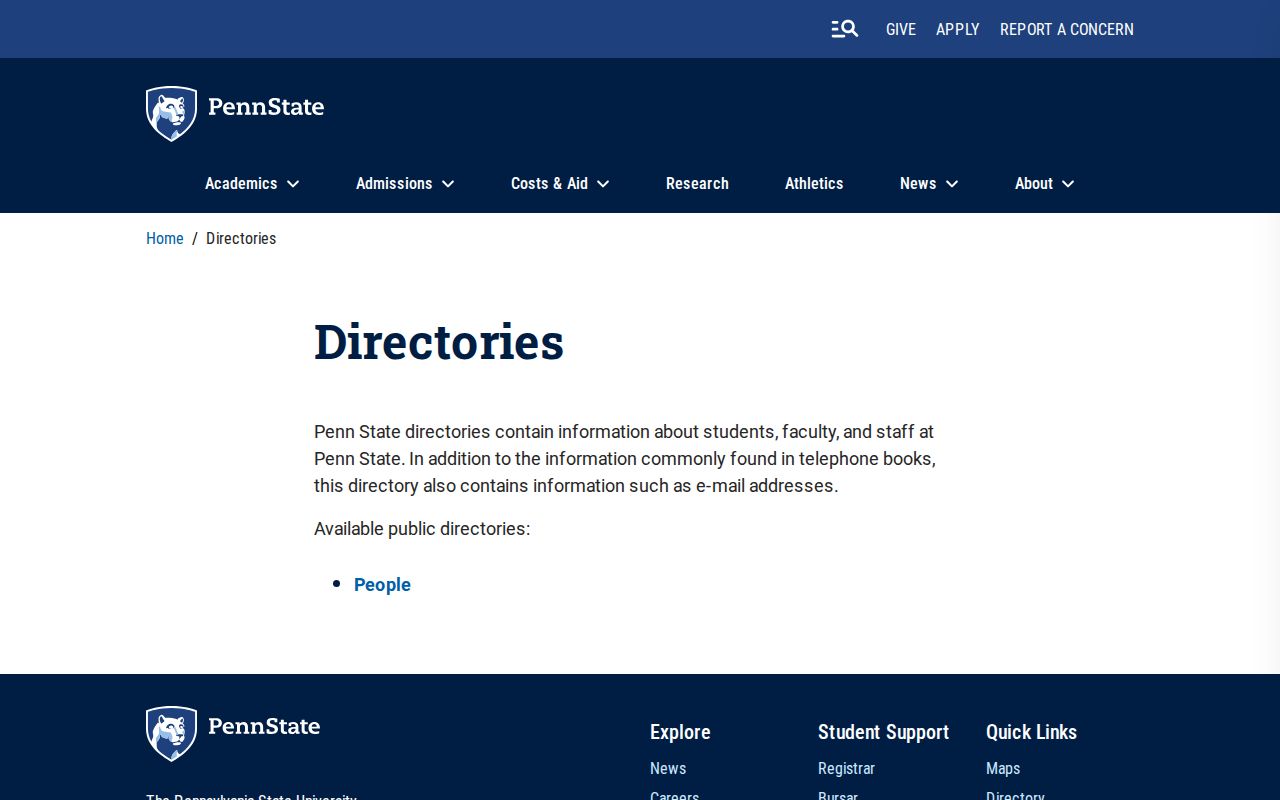
The Penn State directory gateway covers students, faculty, and staff across University Park and the Commonwealth Campuses, and it carries email alongside old-fashioned phone-book detail. The switchboard is 1-814-865-4700, and the 814-865 exchange is a University Park pattern locals recognize on sight.
- Penn State - switchboard 1-814-865-4700, with campus directories searchable by person type, title, role, office location, and phone.
- University of Pennsylvania - the Penn Directory public search covers faculty, staff, students, and Penn organizations, with an authenticated view that shows more.
- Free Library of Philadelphia - the system number is 1-833-TALK-FLP, which spells out to 825-5357, and branch pages repeat it.
- Community colleges and intermediate units - each publishes its own admissions, registrar, and early intervention lines.
Penn's directory is offered as a public service and asks that it not be used for solicitation. Phone numbers are suppressed for people who opt out, so a missing number does not mean a missing person.
Pennsylvania Utility Phone Numbers
The single most common mistake with Pennsylvania utility phone numbers is calling the billing line about a leak. Gas and electric companies keep those separate on purpose. Emergency lines answer around the clock. Customer service lines keep office hours. If you smell gas, you call the emergency number, and you call it from outside the building.
| Service | Emergency or Outage | Customer Service |
|---|---|---|
| UGI gas and electric | 800-276-2722, answered 24 hours | 800-276-2722, weekdays 8 AM to 5 PM |
| Peoples Natural Gas | 1-800-400-4271 for leaks, gas odor, damaged lines, or carbon monoxide symptoms | Contact page only, not for urgent requests |
| Philadelphia Gas Works | Confirm the current emergency line on the PGW contact page | 215-235-1000 |
| Pennsylvania One Call | Dial 811 before digging, or 800-242-1776 from a number outside Pennsylvania | |
| 511PA road conditions | Dial 511 | 1-877-511-PENN |
| Pennsylvania Turnpike incidents | *11 from a cell phone, or 1-800-332-3880 | paturnpike.com |
| Public Utility Commission | Not an emergency line | 1-800-692-7380 |
PECO, PPL Electric, and the FirstEnergy companies (Met-Ed, Penelec, Penn Power, and West Penn Power) all run their own outage and billing lines, and those change often enough that the company's own page is the only number worth trusting. Water and sewer service is even more local, since it may come from a municipal authority, a city water department, or a private company depending on the block.
The Public Utility Commission is the regulator and the complaint fallback, not the dispatcher. Call the utility first. If that goes nowhere, the PUC consumer line is 1-800-692-7380, and formal complaint forms can be mailed after a request to the Secretary's Bureau at 717-772-7777.
Note: Pennsylvania One Call handles the 811 request online as well as by phone, and the ticket has to be filed before the shovel goes in the ground.
Health and Social Services Numbers in Pennsylvania
Pennsylvania health numbers split between statewide lines and county-run programs. The Department of Health takes public health emergency and reportable-condition calls at 877-PA-HEALTH, which dials as 877-724-3258, and that line runs 24 hours. Vital Records handles birth and death certificates, with help at 724-656-3100 or toll free at 844-228-3516. The Philadelphia Vital Records Office moved to appointments only starting October 6, 2025, and those appointments come through Pennsylvania Vital Records rather than a walk-in line.
Behavioral health runs on 988 first. Every Pennsylvania county is also required to provide crisis intervention services, so there is a county crisis line behind the statewide one, and the county human services page or PA 211 will find it. Substance use treatment referrals route through the Get Help Now line at 1-800-662-HELP. The state reported that Get Help Now made more than 6,200 treatment referrals in a year, and that Pennsylvania 988 centers answered more than 129,000 calls in 2025.
Human services benefit lines change routing more often than most numbers on this list. Confirm them on the Department of Human Services or COMPASS pages before you rely on one.
County Phone Numbers Across Pennsylvania
Sixty-seven counties handle a large share of the government business people actually phone about. Deeds, wills, marriage licenses, property assessment, tax claim, elections, the sheriff, the jail, children and youth services, the area agency on aging, veterans affairs, and the courts are all county functions in Pennsylvania. Bigger counties publish deep staff directories with a line for nearly every department. Smaller counties may list a dozen numbers and a main switchboard.
Courts are the one county layer with a genuinely good statewide directory.
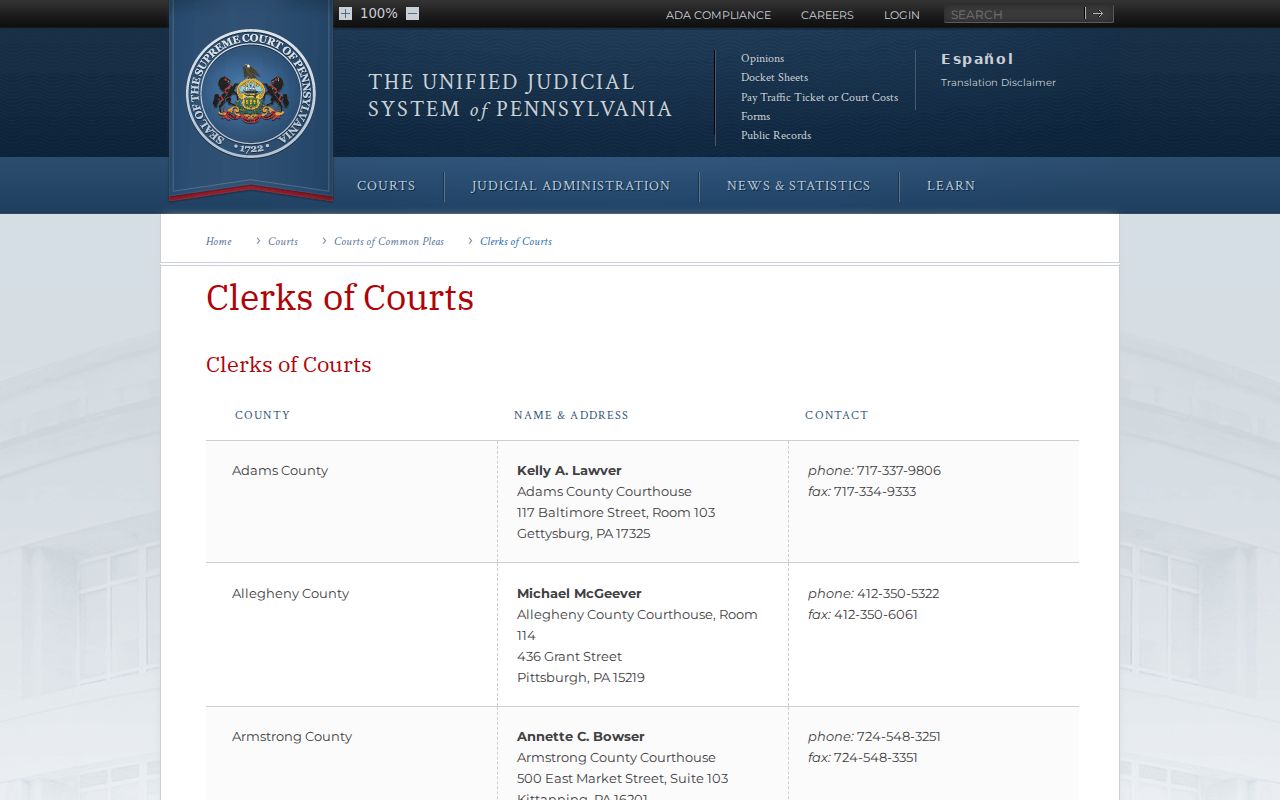
The Unified Judicial System's clerks of courts directory gives every county a row with the clerk's name, the courthouse address, a phone, and a fax. Adams County answers at 717-337-9806, Allegheny at 412-350-5322, Berks at 610-478-6550, Dauphin at 717-780-6530, and Delaware at 610-891-4224. There is a matching directory for magisterial district judges, which is where traffic citations, landlord and tenant cases, small claims, and preliminary criminal hearings land outside Philadelphia.
Public defenders do not work that way. Each of the 67 counties runs its own office, and representation comes from the county where the case was filed, so there is no statewide intake number to call.
Looking Up an Unknown Pennsylvania Number
Official channels and commercial tools answer two different questions about a Pennsylvania number. Government sites tell you what a number is and let you file a complaint about it. They will not hand you a name. Commercial lookup tools try to name the caller, and they are often right, but they are guessing from data they bought or collected rather than from a carrier record.
Start with what the number itself tells you. The area code and the three digits after it point to the rate center where the prefix was first assigned and the company that received it, which NANPA publishes. Then remember why that is only a clue. Number portability lets a subscriber carry a number to a new carrier. Wireless pooling splits a prefix into thousand-number blocks across companies. A VoIP provider can hand out a 412 number to someone who has never been to Pittsburgh.
Official routes worth knowing: the FCC Consumer Complaint Center covers unwanted calls, texts, spoofing of your own number, and bad spam labels, and it also takes complaints by phone at 1-888-225-5322. The FTC Do Not Call Registry handles registration and telemarketing reports. The Reassigned Numbers Database is real but is a paid compliance service for businesses, not a who-called-me tool. On the commercial side, Whitepages, NumLookup, Truecaller, RoboKiller, and YouMail all publish reverse lookups, and your own carrier's app labels spam on your line for free. The full walkthrough, including what each tool returns, lives on the Pennsylvania phone numbers page.
Common Scam Calls and How to Report Them
The scripts that work in Pennsylvania are the ones that borrow a local name. Callers claim to be the Attorney General's office, a county sheriff, a court clerk chasing a missed jury summons, or the IRS. Utility shutoff threats spoof PECO, PPL, UGI, PGW, Peoples, and municipal authorities, usually with a payment deadline measured in minutes. Grandparent scams use a spoofed local number and, more and more, a cloned voice. Benefits and insurance calls fish for Social Security or bank details. Bank fraud calls ask you to read back a one-time code, which no real bank does.
One clarification worth repeating: 988 is a crisis line. It is not a collection agency and not law enforcement, so a call claiming otherwise is not coming from 988.
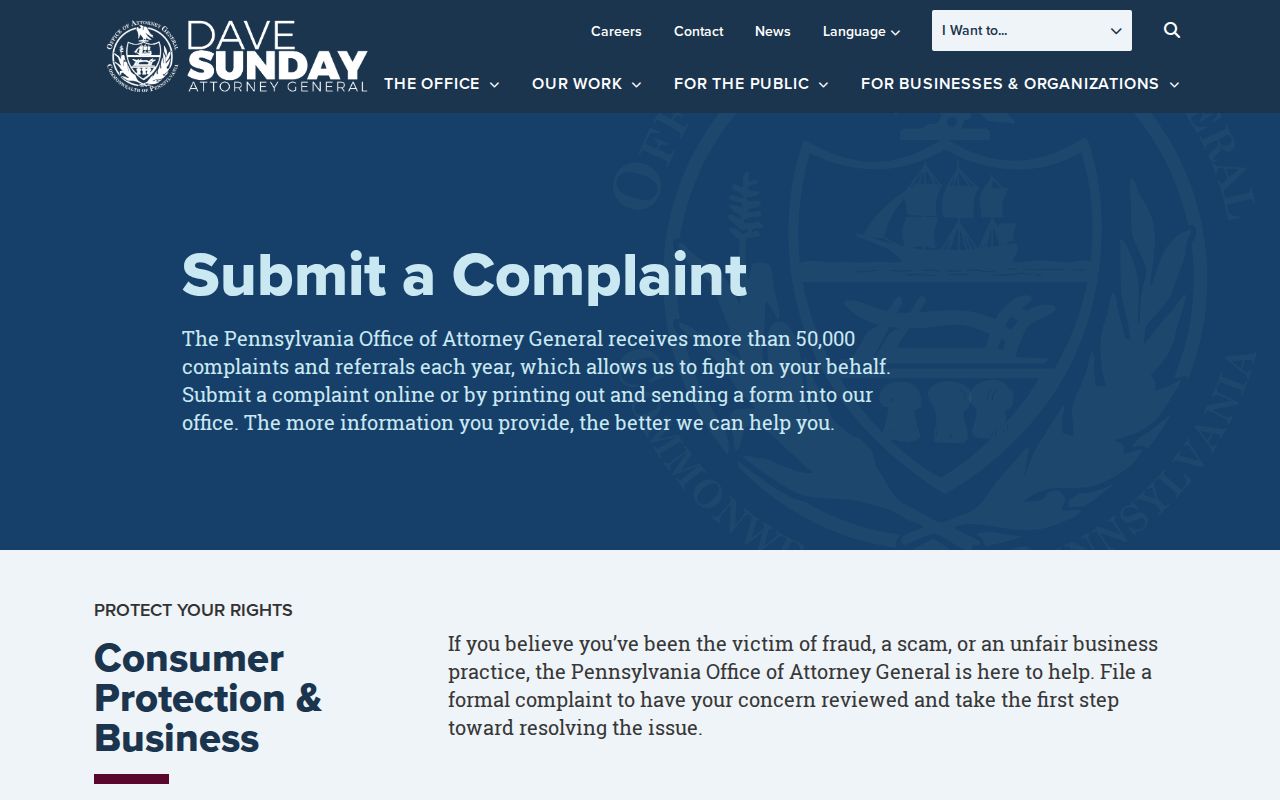
The Attorney General's complaint portal routes consumer complaints, Do Not Call complaints, and scam reports, and the scam forms are published in Spanish, Cambodian, Korean, Simple Chinese, and Vietnamese as well as English. The main office line is 717-787-3391. Reporting works best as three parallel filings: the FTC for telemarketing, the FCC for robocalls and spoofing, and the Attorney General for anything that looks like fraud. If a utility is involved, the PUC takes that one.
Note: write down the calling number, the date and time, and anything the voicemail said before you file, because a specific report moves faster than a vague one.
Community Phone Resources in Pennsylvania
PA 211 is the Pennsylvania resource most people have never used and should. It is not a government switchboard. It is a live, searchable directory of local help, covering food, housing, utility assistance, health care, caregiving, transportation, childcare, employment, and disaster recovery. You reach it three ways: dial 211, text your ZIP code to 898-211, or search the site. The service runs every day of the year, it is free and confidential, and it advertises support in 240 languages. United Way of Greater Lehigh Valley also publishes 855-567-5341 as an alternate line.
The ZIP-code text is what makes 211 work statewide. Services differ enormously between Philadelphia, a Poconos township, and a Potter County borough, and the ZIP tells the system which county's resources to pull.
Below that, county-level directories are usually more precise than any statewide list. Area agencies on aging, county human services, county drug and alcohol offices, community action agencies, and United Way affiliates each keep their own. For legal help, the Pennsylvania Legal Aid Network routes people by location and problem type, and the Pennsylvania Bar Association handles lawyer referral separately.
Phone Numbering Basics for Pennsylvania
Pennsylvania numbers follow the North American plan, which means a country code of +1 and then ten digits. Those ten digits break into a three-digit area code, a three-digit prefix, and a four-digit line number. Writing a contact as +1 followed by the ten digits is the format that survives travel, roaming, and moving your contacts to a new phone. For calls out of the country from a landline, 011 comes first, then the country code.
A few terms show up constantly once you start reading numbering material.
- NPA
- The area code. Three digits, and the label stands for numbering plan area.
- NXX
- The three digits right after the area code. Carriers get these in blocks, and each block ties back to a rate center.
- Overlay
- Adding a new area code over the same territory instead of redrawing the map. Existing numbers stay put, and every local call needs all ten digits.
- Rate center
- The billing area a prefix belongs to. Harrisburg, Erie, and Scranton are each their own.
- Portability
- The rule that lets you keep a number when you switch carriers, which is why the original carrier on record is often wrong.
Phone Service History in Pennsylvania
Pennsylvania's telephone story starts with Bell exchanges in Philadelphia and Pittsburgh and turns into a numbering story in 1947, when the first area codes were drawn. Four codes covered the whole state, and they held for almost half a century. Then the pressure arrived all at once. In January 1994, 610 split away from 215 and took most of suburban southeastern Pennsylvania. In February 1998, 724 split from 412 for the Pittsburgh suburbs and the southwest. In April 1999, 717 split, with the north becoming 570.
After that the state stopped cutting the map. Overlays came instead: 267 over 215 and 484 over 610 in 1999, 878 over 412 and 724 in 2001, 272 over 570 in 2013, 223 over 717 in 2017, 445 over 215 and 267 in 2018, 582 over 814 in 2021, and 835 over 610 and 484 in 2022.
The old codes kept their meaning anyway. Say 215 and people hear Philadelphia. Say 412 and people hear Pittsburgh, where the code is close to a civic logo. 717 still means the Harrisburg, Lancaster, and York belt. 814 stretches from Erie to Johnstown and somehow still reads as one place. The newer overlays work exactly the same technically, but nobody has gotten attached to them yet.
Recent Phone News in Pennsylvania
Enforcement has been the main Pennsylvania phone story lately. In 2025 the Attorney General's office launched Operation Robocall Roundup, sending warnings to dozens of telecom companies accused of ignoring federal robocall rules. The angle there is worth noticing: the state went after the voice providers carrying illegal traffic, not only the individual scammers, and it did so alongside other state attorneys general.
On the numbering side, NANPA's reports page carried a July 6, 2026 update to its NRUF data and April 2026 exhaust analysis files. Nothing in the official NANPA or Public Utility Commission material reviewed in July 2026 pointed to a new Pennsylvania area code beyond the overlays already in service.
Note: Area code assignments and dialing rules do change, so confirm them against current NANPA reports before trusting an older page or printed list.
Frequently Asked Questions
Do I have to dial ten digits in Pennsylvania?
In practice, yes, and treating ten digits as the default is the simplest habit. Every overlay region in the state requires the area code on local calls, because the same seven digits can exist under two or three different codes in the same town. The 814 region joined that list when 582 arrived, and the federal 988 rollout pushed the last seven-digit holdouts over by October 24, 2021. Some toll calls still want a 1 in front of the ten digits, depending on your carrier.
Where is the official Pennsylvania state phone book?
The Department of General Services publishes the Commonwealth Telephone Directory, and it is the closest thing to an official statewide book. It covers state agencies, bureaus, and offices rather than private residents or local government. It comes as a PDF you can read online or download, organized agency by agency, and the 2026 edition is current. Use your browser's find function inside the PDF rather than looking for a search box on the page.
Which area code covers my part of Pennsylvania?
Six regions, fifteen codes. Philadelphia and the close southeast use 215, 267, and 445. The Lehigh Valley, Reading, and the suburban southeast use 610, 484, and 835. South-central Pennsylvania uses 717 and 223. The northeast and north-central counties use 570 and 272. The northwest and central counties use 814 and 582. Pittsburgh and the southwest use 412, 724, and 878. Because these are overlays, your neighbor's newer number may carry a different code than yours.
My township has no police department. Who do I call?
The Pennsylvania State Police provide local coverage in many municipalities that have no department of their own. Find your covering barracks in the State Police station directory, which lists each station by county with its address and phone. Headquarters answers non-emergency business at 717-783-5599 during business hours, but the local station is the better call for anything about your area. Emergencies still go to 911 through your county center.
Does 311 work everywhere in Pennsylvania?
No. 311 is a city service, not a state service. Philadelphia runs Philly311 for non-emergency requests, and Pittsburgh runs its own 311 Response Center. Outside cities that operate one, dialing 311 goes nowhere useful. For a borough or township, the main office line or the manager's office is the realistic way to reach a person. For help finding a service rather than an office, 211 works statewide.
How do I report a robocall in Pennsylvania?
File in more than one place, because each agency handles a different piece. The FTC takes telemarketing complaints once your number has been on the Do Not Call Registry for 31 days. The FCC takes robocalls, spoofing, and spam-label problems. The Attorney General takes scam and Pennsylvania Do Not Call complaints, with forms in several languages. The Public Utility Commission takes utility-related calls at 1-800-692-7380. Report to your local police or the State Police if you lost money.